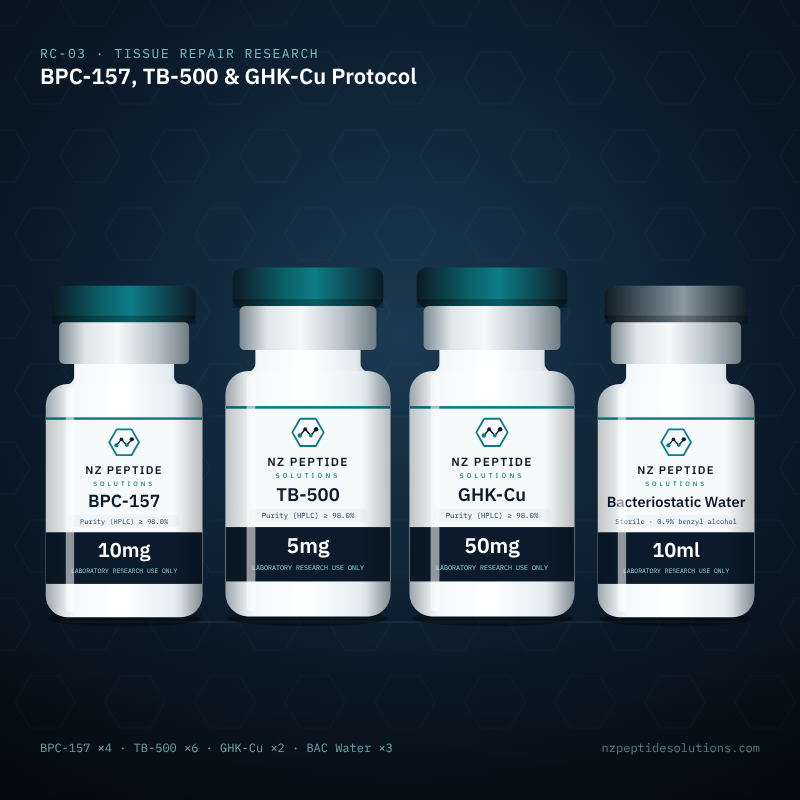
BPC-157, TB-500 & GHK-Cu Protocol
Tissue Repair Research protocol comprising BPC-157, TB-500 and GHK-Cu, with batch Certificates of Analysis.
Research use only. 18+ required. Batch CoA documentation. Secure Stripe checkout. Tracked NZ dispatch.
Specification: Compounds Supplied
Each compound is supplied in matched quantities for the protocol's study design.
| Compound | Vials | Total Quantity Supplied |
|---|---|---|
| BPC-157 10mg | 4 vials | 40mg total |
| TB-500 5mg | 6 vials | 30mg total |
| GHK-Cu 50mg | 2 vials | 100mg total |
| Bacteriostatic Water 10ml | 3 vials | 30ml total |
Research Context
GHK-Cu has extensive research in collagen synthesis, fibroblast proliferation, anti-inflammatory activity, and wound contraction.
BPC-157 and TB-500 work through complementary mechanisms. GHK-Cu is added for its collagen matrix remodelling properties, making this the most comprehensive recovery protocol.
All compounds are sold for research purposes only.
Research context summarises published preclinical literature and makes no claim of effect. All compounds are supplied for laboratory research use only.
Storage & Handling
- - Store lyophilised material at -20°C, protected from light and moisture.
- - Hold reconstituted material at 2-8°C within the validated stability window for the study design.
- - Handle only in an appropriately equipped laboratory using standard PPE.
- - Dispose of material in accordance with local laboratory waste regulations.
Research Use & Handling
Intended Research Use
Supplied for in vitro laboratory research and analytical reference use only. Not for human consumption, animal consumption, diagnostic, therapeutic, cosmetic, or in vivo use of any kind.
Documentation Available
- - Certificate of Analysis (CoA)
- - Batch and lot identification
- - Purity and identity verification by HPLC and mass spectrometry
Handling Notes
Store lyophilised material at -20 degrees C, protected from light and moisture. Once reconstituted, store at 2 to 8 degrees C and use within the validated stability window for your protocol. Handle only in an appropriately equipped laboratory with standard PPE. Dispose of all material in accordance with local laboratory waste regulations.
Full compliance details on our Research Use Only policy page.
Quality & Documentation
Batch Documentation
Certificate of Analysis (COA) available for every batch. Contact us with your batch number for full documentation.
Research literature
18 peer-reviewed references · PubMedPublished studies on the compounds in this research protocol, listed for scientific context. References describe published research only and do not indicate that any product is intended or suitable for human or animal use.
BPC-157
- Emerging Use of BPC-157 in Orthopaedic Sports Medicine: A Systematic Review
Vasireddi N et al. HSS journal : the musculoskeletal journal of Hospital for Special Surgery, 2025Systematic reviewPMID 40756949
- Stable Gastric Pentadecapeptide BPC 157 and Intestinal Anastomoses Therapy in Rats-A Review
Bajramagic S et al. Pharmaceuticals (Basel, Switzerland), 2024ReviewPMID 39204186
- Pentadecapeptide BPC 157 and the central nervous system
Vukojevic J et al. Neural regeneration research, 2022ReviewPMID 34380875
- Stable Gastric Pentadecapeptide BPC 157 and Wound Healing
Seiwerth S et al. Frontiers in pharmacology, 2021ReviewPMID 34267654
- Gastric pentadecapeptide body protection compound BPC 157 and its role in accelerating musculoskeletal soft tissue healing
Gwyer D et al. Cell and tissue research, 2019ReviewPMID 30915550
- Gastric pentadecapeptide BPC 157 accelerates healing of transected rat Achilles tendon and in vitro stimulates tendocytes growth
Staresinic M et al. Journal of orthopaedic research : official publication of the Orthopaedic Research Society, 2003Animal studyPMID 14554208
TB-500
- Thymosin β4: A Multi-Faceted Tissue Repair Stimulating Protein in Heart Injury
Bjørklund G et al. Current medicinal chemistry, 2020ReviewPMID 31333080
- A new insight into thymosin β4, a promising therapeutic approach for neurodegenerative disorders
Shomali N et al. Journal of cellular physiology, 2020ReviewPMID 31612500
- Thymosin β4 Promotes Dermal Healing
Kleinman HK, Sosne G Vitamins and hormones, 2016ReviewPMID 27450738
- Thymosin β4: a multi-functional regenerative peptide. Basic properties and clinical applications
Goldstein AL et al. Expert opinion on biological therapy, 2012ReviewPMID 22074294
- Thymosin beta 4 as an Alzheimer disease intervention target identified using human brain organoids
Zeng PM et al. Stem cell reports, 2025Animal studyPMID 40816274
- Thymosin β4 stabilizes hypoxia induced brain microvascular endothelial cell dysfunction through S1PR1 dependent mechanisms
Stewart WG et al. Scientific reports, 2025In vitro studyPMID 41326489
GHK-Cu
- Topically applied GHK as an anti-wrinkle peptide: Advantages, problems and prospective
Mortazavi SM et al. BioImpacts : BI, 2025ReviewPMID 39963574
- The potential of GHK as an anti-aging peptide
Dou Y et al. Aging pathobiology and therapeutics, 2020ReviewPMID 35083444
- Regenerative and Protective Actions of the GHK-Cu Peptide in the Light of the New Gene Data
Pickart L, Margolina A International journal of molecular sciences, 2018ReviewPMID 29986520
- GHK Peptide as a Natural Modulator of Multiple Cellular Pathways in Skin Regeneration
Pickart L et al. BioMed research international, 2015ReviewPMID 26236730
- The human tripeptide GHK-Cu in prevention of oxidative stress and degenerative conditions of aging: implications for cognitive health
Pickart L et al. Oxidative medicine and cellular longevity, 2012ReviewPMID 22666519
- Glycyl-l-histidyl-l-lysine-Cu(2+) rescues cigarette smoking-induced skeletal muscle dysfunction via a sirtuin 1-dependent pathway
Deng M et al. Journal of cachexia, sarcopenia and muscle, 2023Animal studyPMID 36905132
Literature compiled from PubMed, 2026-11-24.
Research Use Only: This product is intended for laboratory research purposes only. Not for human or animal consumption. Not intended for medical, diagnostic, or therapeutic use. Read full policy.
From the Research Hub
$449.00
Select format