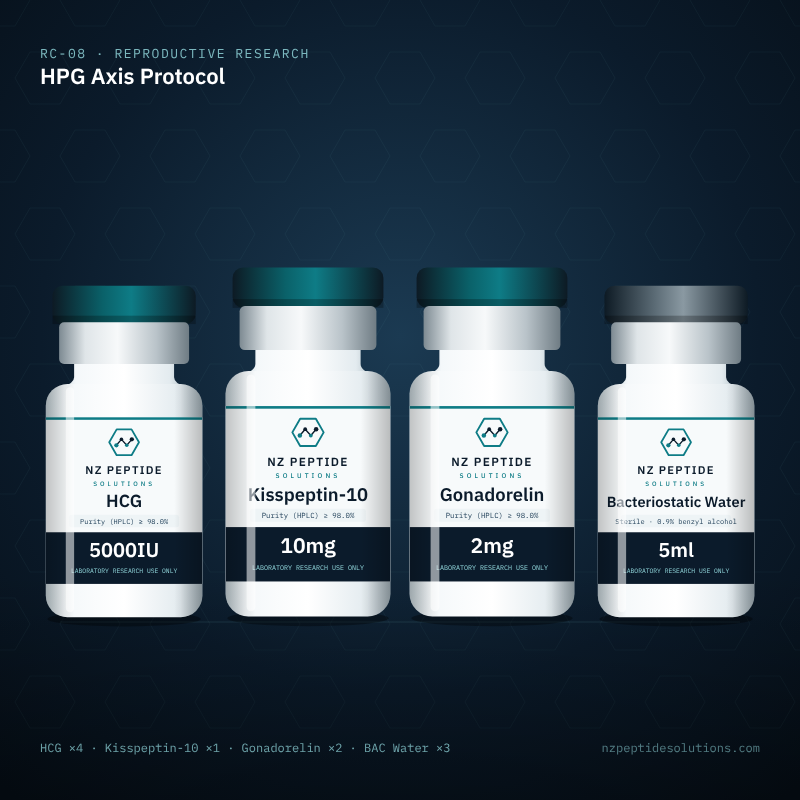
HPG Axis Protocol
Reproductive Research protocol comprising HCG, Kisspeptin-10 and Gonadorelin, with batch Certificates of Analysis.
Research use only. 18+ required. Batch CoA documentation. Secure Stripe checkout. Tracked NZ dispatch.
Specification: Compounds Supplied
Each compound is supplied in matched quantities for the protocol's study design.
| Compound | Vials | Total Quantity Supplied |
|---|---|---|
| HCG 5000IU | 4 vials | 20000 IU total |
| Kisspeptin-10 10mg | 1 vial | 10mg total |
| Gonadorelin 2mg | 2 vials | 4mg total |
| Bacteriostatic Water 5ml | 3 vials | 15ml total |
Research Context
This protocol addresses HPG axis restoration following suppression. HCG acts as an LH analogue at Leydig cells, directly stimulating testosterone production independent of pituitary LH. Kisspeptin-10 works upstream to re-establish hypothalamic GnRH pulsatility. Gonadorelin bridges the gap between hypothalamic action and pituitary responsiveness.
The three-compound approach targets each level of the HPG axis simultaneously for speed and completeness of hormonal recovery.
All compounds are sold for research purposes only.
Research context summarises published preclinical literature and makes no claim of effect. All compounds are supplied for laboratory research use only.
Storage & Handling
- - Store lyophilised material at -20°C, protected from light and moisture.
- - Hold reconstituted material at 2-8°C within the validated stability window for the study design.
- - Handle only in an appropriately equipped laboratory using standard PPE.
- - Dispose of material in accordance with local laboratory waste regulations.
Research Use & Handling
Intended Research Use
Supplied for in vitro laboratory research and analytical reference use only. Not for human consumption, animal consumption, diagnostic, therapeutic, cosmetic, or in vivo use of any kind.
Documentation Available
- - Certificate of Analysis (CoA)
- - Batch and lot identification
- - Purity and identity verification by HPLC and mass spectrometry
Handling Notes
Store lyophilised material at -20 degrees C, protected from light and moisture. Once reconstituted, store at 2 to 8 degrees C and use within the validated stability window for your protocol. Handle only in an appropriately equipped laboratory with standard PPE. Dispose of all material in accordance with local laboratory waste regulations.
Full compliance details on our Research Use Only policy page.
Quality & Documentation
Batch Documentation
Certificate of Analysis (COA) available for every batch. Contact us with your batch number for full documentation.
Research literature
9 peer-reviewed references · PubMedPublished studies on the compounds in this research protocol, listed for scientific context. References describe published research only and do not indicate that any product is intended or suitable for human or animal use.
Kisspeptin-10
- Kisspeptin-10 Ameliorates Obesity-Diabetes with Diverse Effects on Ileal Enteroendocrine Cells and Pancreatic Islet Morphology in High-Fat Fed Female Mice
Sridhar A et al. Biomolecules, 2025Animal studyPMID 41301510
- Kisspeptin-10 binding to Gpr54 in osteoclasts prevents bone loss by activating Dusp18-mediated dephosphorylation of Src
Li Z et al. Nature communications, 2024Animal studyPMID 38346942
- Centrally injected kisspeptin reduces food intake by increasing meal intervals in mice
Stengel A et al. Neuroreport, 2011Animal studyPMID 21386700
- Kisspeptin 10 Inhibited the Proliferation, Migration, and Stemness of Esophageal Cancer Cells via Regulating the SIX1/Wnt/β-Catetin Signaling
Guo C et al. Journal of biochemical and molecular toxicology, 2025In vitro studyPMID 40192612
- KISS1R and ANKRD31 Cooperate to Enhance Leydig Cell Gene Expression via the Cytoskeletal-Nucleoskeletal Pathway
Ricci G et al. Frontiers in cell and developmental biology, 2022In vitro studyPMID 35813201
HCG
- Factors affecting spermatogenesis upon gonadotropin-replacement therapy: a meta-analytic study
Rastrelli G et al. Andrology, 2014Meta-analysisPMID 25271205
- Systematic review of hormone replacement therapy in the infertile man
El Meliegy A et al. Arab journal of urology, 2018Systematic reviewPMID 29713545
- Optimal restoration of spermatogenesis after testosterone therapy using human chorionic gonadotropin and follicle-stimulating hormone
Stocks BT et al. Fertility and sterility, 2025Human studyPMID 39442683
- Non-testosterone management of male hypogonadism: an examination of the existing literature
Krzastek SC, Smith RP Translational andrology and urology, 2020ReviewPMID 32257856
Literature compiled from PubMed, 2026-11-24.
Research Use Only: This product is intended for laboratory research purposes only. Not for human or animal consumption. Not intended for medical, diagnostic, or therapeutic use. Read full policy.
From the Research Hub
$499.00
Select format