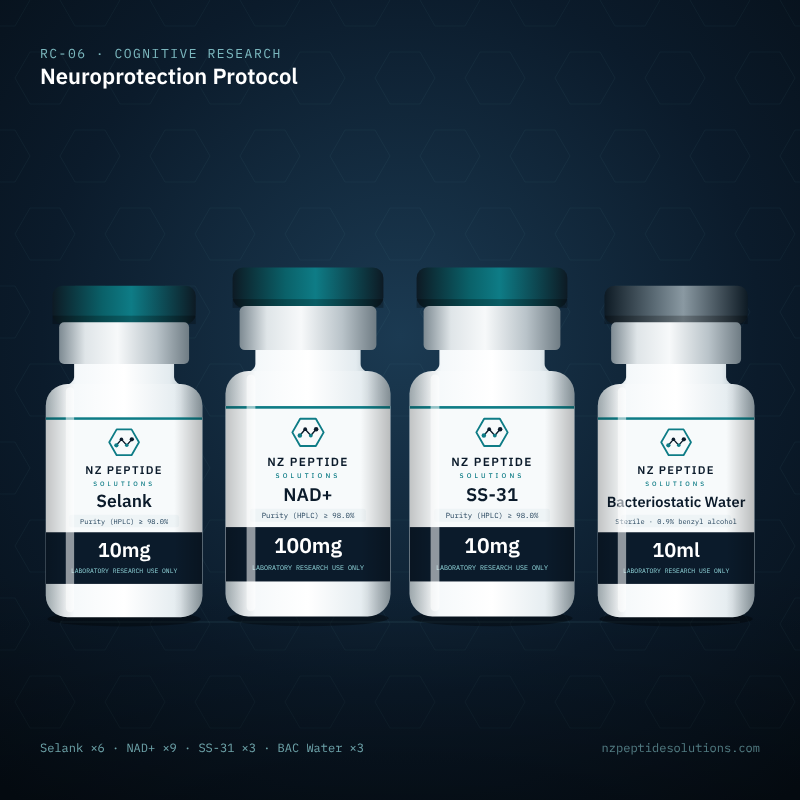
Neuroprotection Protocol
Cognitive Research protocol comprising Selank, NAD+ and SS-31, with batch Certificates of Analysis.
Research use only. 18+ required. Batch CoA documentation. Secure Stripe checkout. Tracked NZ dispatch.
Specification: Compounds Supplied
Each compound is supplied in matched quantities for the protocol's study design.
| Compound | Vials | Total Quantity Supplied |
|---|---|---|
| Selank 10mg | 6 vials | 60mg total |
| NAD+ 100mg | 9 vials | 900mg total |
| SS-31 10mg | 3 vials | 30mg total |
| Bacteriostatic Water 10ml | 3 vials | 30ml total |
Research Context
This protocol addresses cognitive aging from two directions: the neurotransmitter/BDNF angle (Selank) and the mitochondrial/energetic angle (SS-31 + NAD+). SS-31 (Elamipretide) binds cardiolipin in the inner mitochondrial membrane, stabilising cristae structure, supporting the electron transport chain, and reducing mitochondrial ROS.
Together, Selank (central neurotrophic support), NAD+ (cellular energy substrate), and SS-31 (mitochondrial structural protection) represent a three-pathway approach to neurological aging.
All compounds are sold for research purposes only.
Research context summarises published preclinical literature and makes no claim of effect. All compounds are supplied for laboratory research use only.
Storage & Handling
- - Store lyophilised material at -20°C, protected from light and moisture.
- - Hold reconstituted material at 2-8°C within the validated stability window for the study design.
- - Handle only in an appropriately equipped laboratory using standard PPE.
- - Dispose of material in accordance with local laboratory waste regulations.
Research Use & Handling
Intended Research Use
Supplied for in vitro laboratory research and analytical reference use only. Not for human consumption, animal consumption, diagnostic, therapeutic, cosmetic, or in vivo use of any kind.
Documentation Available
- - Certificate of Analysis (CoA)
- - Batch and lot identification
- - Purity and identity verification by HPLC and mass spectrometry
Handling Notes
Store lyophilised material at -20 degrees C, protected from light and moisture. Once reconstituted, store at 2 to 8 degrees C and use within the validated stability window for your protocol. Handle only in an appropriately equipped laboratory with standard PPE. Dispose of all material in accordance with local laboratory waste regulations.
Full compliance details on our Research Use Only policy page.
Quality & Documentation
Batch Documentation
Certificate of Analysis (COA) available for every batch. Contact us with your batch number for full documentation.
Research literature
18 peer-reviewed references · PubMedPublished studies on the compounds in this research protocol, listed for scientific context. References describe published research only and do not indicate that any product is intended or suitable for human or animal use.
NAD+
- The Safety and Antiaging Effects of Nicotinamide Mononucleotide in Human Clinical Trials: an Update
Song Q et al. Advances in nutrition (Bethesda, Md.), 2023ReviewPMID 37619764
- NAD(+) metabolism and its roles in cellular processes during ageing
Covarrubias AJ et al. Nature reviews. Molecular cell biology, 2021ReviewPMID 33353981
- NAD(+) homeostasis in health and disease
Katsyuba E et al. Nature metabolism, 2020ReviewPMID 32694684
- NAD(+) Intermediates: The Biology and Therapeutic Potential of NMN and NR
Yoshino J et al. Cell metabolism, 2018ReviewPMID 29249689
- NAD⁺ in aging, metabolism, and neurodegeneration
Verdin E Science (New York, N.Y.), 2015ReviewPMID 26785480
- NAD+ and sirtuins in aging and disease
Imai S, Guarente L Trends in cell biology, 2014ReviewPMID 24786309
SS-31
- Elamipretide: First Approval
Shirley M Drugs, 2026ReviewPMID 41335372
- Elamipretide: A Review of Its Structure, Mechanism of Action, and Therapeutic Potential
Tung C et al. International journal of molecular sciences, 2025ReviewPMID 39940712
- Targeting mitochondrial dysfunction with elamipretide
Obi C et al. Heart failure reviews, 2022ReviewPMID 35037146
- Potential Therapeutic Candidates for Age-Related Macular Degeneration (AMD)
Nashine S Cells, 2021ReviewPMID 34572131
- Elamipretide alleviates pyroptosis in traumatically injured spinal cord by inhibiting cPLA2-induced lysosomal membrane permeabilization
Zhang H et al. Journal of neuroinflammation, 2023Animal studyPMID 36609266
- Elamipretide (SS-31) improves mitochondrial dysfunction, synaptic and memory impairment induced by lipopolysaccharide in mice
Zhao W et al. Journal of neuroinflammation, 2019Animal studyPMID 31747905
Selank
- Selank, a Peptide Analog of Tuftsin, Attenuates Aversive Signs of Morphine Withdrawal in Rats
Konstantinopolsky MA et al. Bulletin of experimental biology and medicine, 2022Animal studyPMID 36322304
- Morphological Changes in the Large Intestine of Rats Subjected to Chronic Restraint Stress and Treated with Selank
Mukhina AY et al. Bulletin of experimental biology and medicine, 2020Animal studyPMID 32651826
- Effect of Selank on Morphological Parameters of Rat Liver in Chronic Foot-Shock Stress
Fomenko EV et al. Bulletin of experimental biology and medicine, 2019Animal studyPMID 31243679
- State of Colon Microbiota in Rats during Chronic Restraint Stress and Selank Treatment
Mukhina AY et al. Bulletin of experimental biology and medicine, 2019Animal studyPMID 31236882
- Selank Inhibits Ethanol-Induced Hyperlocomotion and Manifestation of Behavioral Sensitization in DBA/2 Mice
Kolik LG et al. Bulletin of experimental biology and medicine, 2016Animal studyPMID 27878720
- Selank and its metabolites maintain homeostasis in the gastric mucosa
Pavlov TS et al. Bulletin of experimental biology and medicine, 2007Animal studyPMID 18019011
Literature compiled from PubMed, 2026-11-24.
Research Use Only: This product is intended for laboratory research purposes only. Not for human or animal consumption. Not intended for medical, diagnostic, or therapeutic use. Read full policy.
From the Research Hub
$599.00
Select format