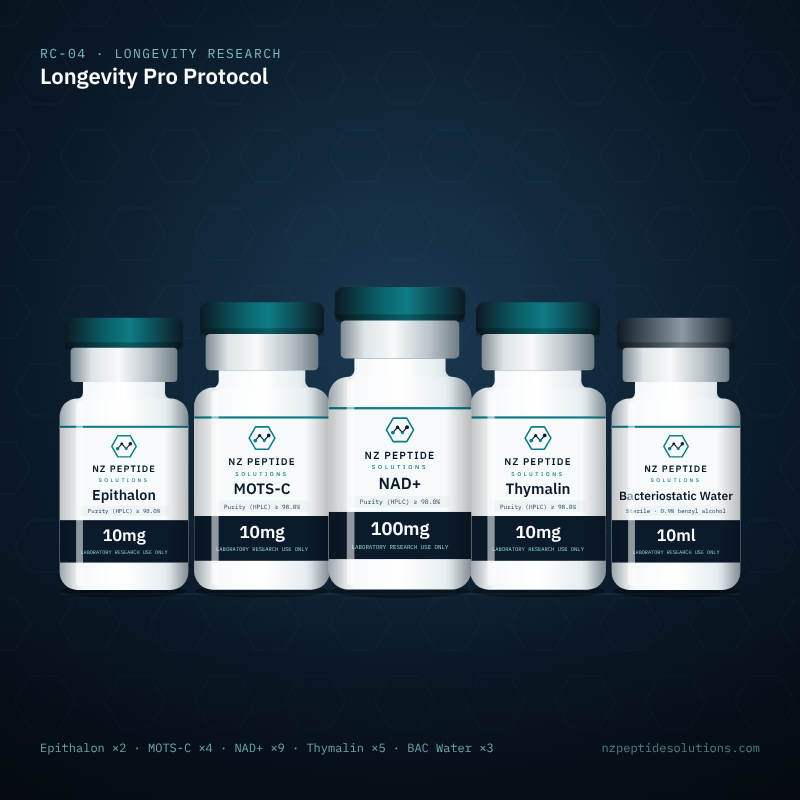
Longevity Pro Protocol
Longevity Research protocol comprising Epithalon, MOTS-C, NAD+ and Thymalin, with batch Certificates of Analysis.
Research use only. 18+ required. Batch CoA documentation. Secure Stripe checkout. Tracked NZ dispatch.
Specification: Compounds Supplied
Each compound is supplied in matched quantities for the protocol's study design.
| Compound | Vials | Total Quantity Supplied |
|---|---|---|
| Epithalon 10mg | 2 vials | 20mg total |
| MOTS-C 10mg | 4 vials | 40mg total |
| NAD+ 100mg | 9 vials | 900mg total |
| Thymalin 10mg | 5 vials | 50mg total |
| Bacteriostatic Water 10ml | 3 vials | 30ml total |
Research Context
This protocol targets four distinct hallmarks of aging simultaneously. Epithalon addresses telomere dynamics and circadian/epigenetic regulation. MOTS-C targets energy metabolism, insulin sensitivity, and mitochondrial decline. NAD+ underpins sirtuin and DNA repair machinery. Thymalin (bovine thymus extract peptide) is studied for thymic regeneration and immune system restoration.
All compounds are sold for research purposes only.
Research context summarises published preclinical literature and makes no claim of effect. All compounds are supplied for laboratory research use only.
Storage & Handling
- - Store lyophilised material at -20°C, protected from light and moisture.
- - Hold reconstituted material at 2-8°C within the validated stability window for the study design.
- - Handle only in an appropriately equipped laboratory using standard PPE.
- - Dispose of material in accordance with local laboratory waste regulations.
Research Use & Handling
Intended Research Use
Supplied for in vitro laboratory research and analytical reference use only. Not for human consumption, animal consumption, diagnostic, therapeutic, cosmetic, or in vivo use of any kind.
Documentation Available
- - Certificate of Analysis (CoA)
- - Batch and lot identification
- - Purity and identity verification by HPLC and mass spectrometry
Handling Notes
Store lyophilised material at -20 degrees C, protected from light and moisture. Once reconstituted, store at 2 to 8 degrees C and use within the validated stability window for your protocol. Handle only in an appropriately equipped laboratory with standard PPE. Dispose of all material in accordance with local laboratory waste regulations.
Full compliance details on our Research Use Only policy page.
Quality & Documentation
Batch Documentation
Certificate of Analysis (COA) available for every batch. Contact us with your batch number for full documentation.
Research literature
23 peer-reviewed references · PubMedPublished studies on the compounds in this research protocol, listed for scientific context. References describe published research only and do not indicate that any product is intended or suitable for human or animal use.
MOTS-c
- MOTS-c: A promising mitochondrial-derived peptide for therapeutic exploitation
Zheng Y et al. Frontiers in endocrinology, 2023ReviewPMID 36761202
- MOTS-c: A potential anti-pulmonary fibrosis factor derived by mitochondria
Zhang Z et al. Mitochondrion, 2023ReviewPMID 37307934
- Mitochondrial-derived microprotein MOTS-c attenuates immobilization-induced skeletal muscle atrophy by suppressing lipid infiltration
Kumagai H et al. American journal of physiology. Endocrinology and metabolism, 2024Animal studyPMID 38170165
- The mitochondrial-derived peptide MOTS-c relieves hyperglycemia and insulin resistance in gestational diabetes mellitus
Yin Y et al. Pharmacological research, 2022Animal studyPMID 34798268
- MOTS-c is an exercise-induced mitochondrial-encoded regulator of age-dependent physical decline and muscle homeostasis
Reynolds JC et al. Nature communications, 2021Animal studyPMID 33473109
- The mitochondrial-derived peptide MOTS-c promotes metabolic homeostasis and reduces obesity and insulin resistance
Lee C et al. Cell metabolism, 2015Animal studyPMID 25738459
NAD+
- The Safety and Antiaging Effects of Nicotinamide Mononucleotide in Human Clinical Trials: an Update
Song Q et al. Advances in nutrition (Bethesda, Md.), 2023ReviewPMID 37619764
- NAD(+) metabolism and its roles in cellular processes during ageing
Covarrubias AJ et al. Nature reviews. Molecular cell biology, 2021ReviewPMID 33353981
- NAD(+) homeostasis in health and disease
Katsyuba E et al. Nature metabolism, 2020ReviewPMID 32694684
- NAD(+) Intermediates: The Biology and Therapeutic Potential of NMN and NR
Yoshino J et al. Cell metabolism, 2018ReviewPMID 29249689
- NAD⁺ in aging, metabolism, and neurodegeneration
Verdin E Science (New York, N.Y.), 2015ReviewPMID 26785480
- NAD+ and sirtuins in aging and disease
Imai S, Guarente L Trends in cell biology, 2014ReviewPMID 24786309
Epithalon
- Pineal-regulating tetrapeptide epitalon improves eye retina condition in retinitis pigmentosa
Khavinson V et al. Neuro endocrinology letters, 2002Clinical trialPMID 12195242
- Overview of Epitalon-Highly Bioactive Pineal Tetrapeptide with Promising Properties
Araj SK et al. International journal of molecular sciences, 2025ReviewPMID 40141333
- Effect of epithalon on the incidence of chromosome aberrations in senescence-accelerated mice
Rosenfeld SV et al. Bulletin of experimental biology and medicine, 2002Animal studyPMID 12360351
- Epitalon increases telomere length in human cell lines through telomerase upregulation or ALT activity
Al-Dulaimi S et al. Biogerontology, 2025In vitro studyPMID 40908429
- The Antioxidant Tetrapeptide Epitalon Enhances Delayed Wound Healing in an in Vitro Model of Diabetic Retinopathy
Gatta M et al. Stem cell reviews and reports, 2025In vitro studyPMID 40493162
- Epitalon protects against post-ovulatory aging-related damage of mouse oocytes in vitro
Yue X et al. Aging, 2022In vitro studyPMID 35413689
Thymalin
- Chrono- and Immunocorrection of Inflammatory Disorders of Internal Reproductive Organs in Women of Reproductive Age
Litvinenko GI et al. Bulletin of experimental biology and medicine, 2015Clinical trialPMID 26033592
- Results and Prospects of Using Activator of Hematopoietic Stem Cell Differentiation in Complex Therapy for Patients with COVID-19
Khavinson VK et al. Stem cell reviews and reports, 2021Human studyPMID 33575961
- Reparative osteogenesis in mandible in cases of filling a bone defect with hydroxyapatite-containing osteotropic material and injecting the surrounding soft tissues with thymalin: experimental and morphological study
Boiko AA et al. Wiadomosci lekarskie (Warsaw, Poland : 1960), 2024Animal studyPMID 38431810
- Effect of Thymalin on the Tumor and Thymus under Conditions of Activation Therapy In Vivo
Zhukova GV et al. Bulletin of experimental biology and medicine, 2018Animal studyPMID 29797130
- Thymalin: Activation of Differentiation of Human Hematopoietic Stem Cells
Khavinson VK et al. Bulletin of experimental biology and medicine, 2020In vitro studyPMID 33237528
Literature compiled from PubMed, 2026-11-24.
Research Use Only: This product is intended for laboratory research purposes only. Not for human or animal consumption. Not intended for medical, diagnostic, or therapeutic use. Read full policy.
From the Research Hub
$599.00
Select format