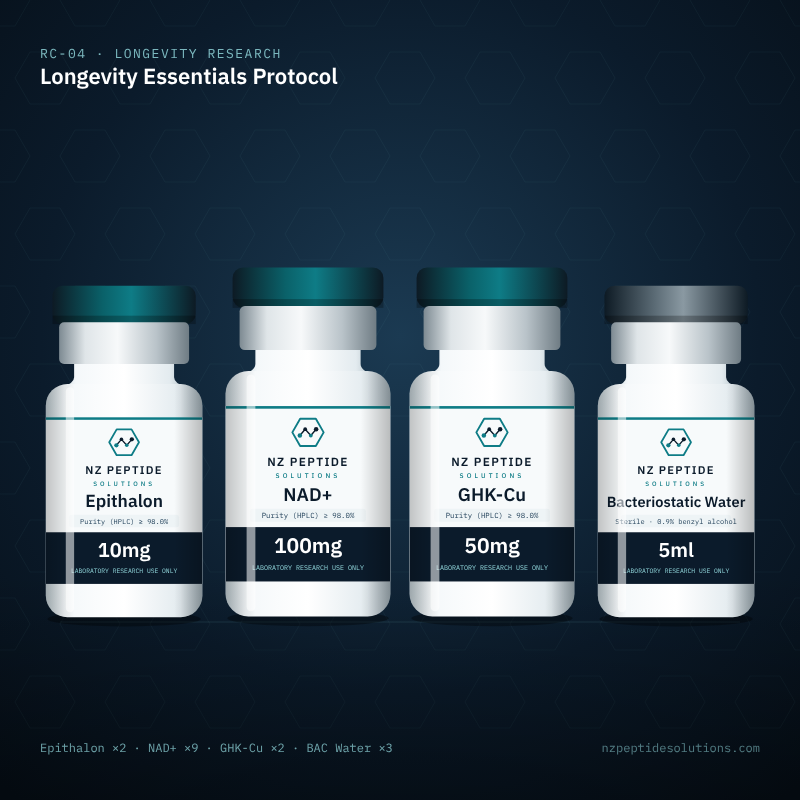
Longevity Essentials Protocol
Longevity Research protocol comprising Epithalon, NAD+ and GHK-Cu, with batch Certificates of Analysis.
Research use only. 18+ required. Batch CoA documentation. Secure Stripe checkout. Tracked NZ dispatch.
Specification: Compounds Supplied
Each compound is supplied in matched quantities for the protocol's study design.
| Compound | Vials | Total Quantity Supplied |
|---|---|---|
| Epithalon 10mg | 2 vials | 20mg total |
| NAD+ 100mg | 9 vials | 900mg total |
| GHK-Cu 50mg | 2 vials | 100mg total |
| Bacteriostatic Water 5ml | 3 vials | 15ml total |
Research Context
Epithalon is a synthetic tetrapeptide developed by Professor Khavinson, researched for pineal gland function, telomerase activation, melatonin normalisation, and circadian rhythm restoration. NAD+ is the master coenzyme of cellular energy metabolism and critical substrate for sirtuins and PARPs. NAD+ levels decline approximately 50% by age 50. GHK-Cu provides ongoing collagen synthesis, wound healing, and anti-inflammatory support.
All compounds are sold for research purposes only.
Research context summarises published preclinical literature and makes no claim of effect. All compounds are supplied for laboratory research use only.
Storage & Handling
- - Store lyophilised material at -20°C, protected from light and moisture.
- - Hold reconstituted material at 2-8°C within the validated stability window for the study design.
- - Handle only in an appropriately equipped laboratory using standard PPE.
- - Dispose of material in accordance with local laboratory waste regulations.
Research Use & Handling
Intended Research Use
Supplied for in vitro laboratory research and analytical reference use only. Not for human consumption, animal consumption, diagnostic, therapeutic, cosmetic, or in vivo use of any kind.
Documentation Available
- - Certificate of Analysis (CoA)
- - Batch and lot identification
- - Purity and identity verification by HPLC and mass spectrometry
Handling Notes
Store lyophilised material at -20 degrees C, protected from light and moisture. Once reconstituted, store at 2 to 8 degrees C and use within the validated stability window for your protocol. Handle only in an appropriately equipped laboratory with standard PPE. Dispose of all material in accordance with local laboratory waste regulations.
Full compliance details on our Research Use Only policy page.
Quality & Documentation
Batch Documentation
Certificate of Analysis (COA) available for every batch. Contact us with your batch number for full documentation.
Research literature
18 peer-reviewed references · PubMedPublished studies on the compounds in this research protocol, listed for scientific context. References describe published research only and do not indicate that any product is intended or suitable for human or animal use.
GHK-Cu
- Topically applied GHK as an anti-wrinkle peptide: Advantages, problems and prospective
Mortazavi SM et al. BioImpacts : BI, 2025ReviewPMID 39963574
- The potential of GHK as an anti-aging peptide
Dou Y et al. Aging pathobiology and therapeutics, 2020ReviewPMID 35083444
- Regenerative and Protective Actions of the GHK-Cu Peptide in the Light of the New Gene Data
Pickart L, Margolina A International journal of molecular sciences, 2018ReviewPMID 29986520
- GHK Peptide as a Natural Modulator of Multiple Cellular Pathways in Skin Regeneration
Pickart L et al. BioMed research international, 2015ReviewPMID 26236730
- The human tripeptide GHK-Cu in prevention of oxidative stress and degenerative conditions of aging: implications for cognitive health
Pickart L et al. Oxidative medicine and cellular longevity, 2012ReviewPMID 22666519
- Glycyl-l-histidyl-l-lysine-Cu(2+) rescues cigarette smoking-induced skeletal muscle dysfunction via a sirtuin 1-dependent pathway
Deng M et al. Journal of cachexia, sarcopenia and muscle, 2023Animal studyPMID 36905132
NAD+
- The Safety and Antiaging Effects of Nicotinamide Mononucleotide in Human Clinical Trials: an Update
Song Q et al. Advances in nutrition (Bethesda, Md.), 2023ReviewPMID 37619764
- NAD(+) metabolism and its roles in cellular processes during ageing
Covarrubias AJ et al. Nature reviews. Molecular cell biology, 2021ReviewPMID 33353981
- NAD(+) homeostasis in health and disease
Katsyuba E et al. Nature metabolism, 2020ReviewPMID 32694684
- NAD(+) Intermediates: The Biology and Therapeutic Potential of NMN and NR
Yoshino J et al. Cell metabolism, 2018ReviewPMID 29249689
- NAD⁺ in aging, metabolism, and neurodegeneration
Verdin E Science (New York, N.Y.), 2015ReviewPMID 26785480
- NAD+ and sirtuins in aging and disease
Imai S, Guarente L Trends in cell biology, 2014ReviewPMID 24786309
Epithalon
- Pineal-regulating tetrapeptide epitalon improves eye retina condition in retinitis pigmentosa
Khavinson V et al. Neuro endocrinology letters, 2002Clinical trialPMID 12195242
- Overview of Epitalon-Highly Bioactive Pineal Tetrapeptide with Promising Properties
Araj SK et al. International journal of molecular sciences, 2025ReviewPMID 40141333
- Effect of epithalon on the incidence of chromosome aberrations in senescence-accelerated mice
Rosenfeld SV et al. Bulletin of experimental biology and medicine, 2002Animal studyPMID 12360351
- Epitalon increases telomere length in human cell lines through telomerase upregulation or ALT activity
Al-Dulaimi S et al. Biogerontology, 2025In vitro studyPMID 40908429
- The Antioxidant Tetrapeptide Epitalon Enhances Delayed Wound Healing in an in Vitro Model of Diabetic Retinopathy
Gatta M et al. Stem cell reviews and reports, 2025In vitro studyPMID 40493162
- Epitalon protects against post-ovulatory aging-related damage of mouse oocytes in vitro
Yue X et al. Aging, 2022In vitro studyPMID 35413689
Literature compiled from PubMed, 2026-11-24.
Research Use Only: This product is intended for laboratory research purposes only. Not for human or animal consumption. Not intended for medical, diagnostic, or therapeutic use. Read full policy.
From the Research Hub
$399.00
Select format