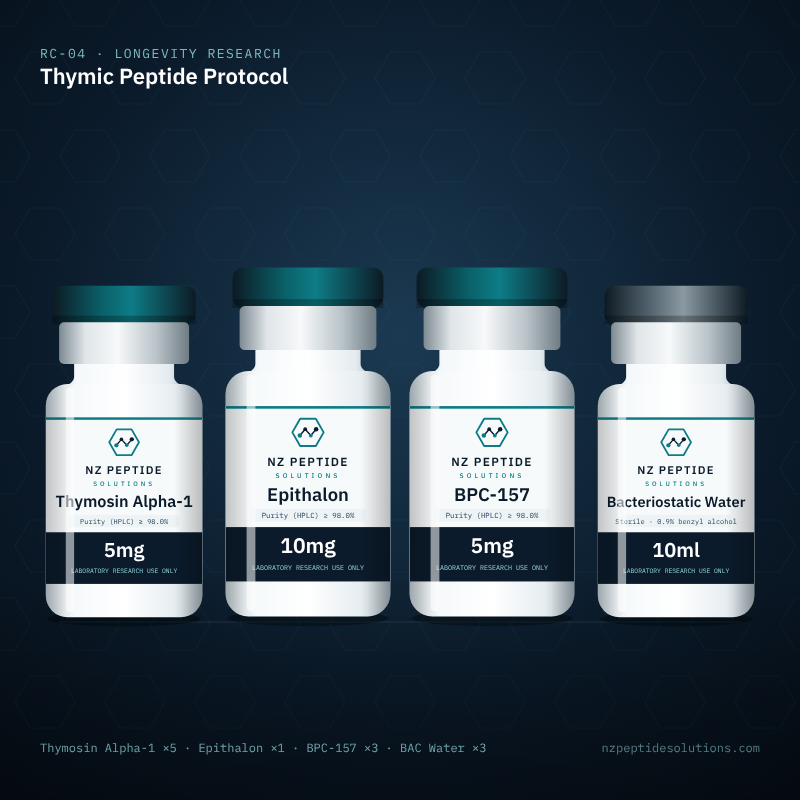
Thymic Peptide Protocol
Longevity Research protocol comprising Thymosin Alpha-1, Epithalon and BPC-157, with batch Certificates of Analysis.
Research use only. 18+ required. Batch CoA documentation. Secure Stripe checkout. Tracked NZ dispatch.
Specification: Compounds Supplied
Each compound is supplied in matched quantities for the protocol's study design.
| Compound | Vials | Total Quantity Supplied |
|---|---|---|
| Thymosin Alpha-1 5mg | 5 vials | 25mg total |
| Epithalon 10mg | 1 vial | 10mg total |
| BPC-157 5mg | 3 vials | 15mg total |
| Bacteriostatic Water 10ml | 3 vials | 30ml total |
Research Context
Thymosin Alpha-1 is a 28-amino acid peptide naturally produced by the thymus, one of the most clinically studied immunomodulatory peptides with approved pharmaceutical use for hepatitis B and C. Research focuses on T-cell maturation, NK cell activity, toll-like receptor upregulation, and immune function restoration.
Epithalon provides pineal-thymus synergy. BPC-157 contributes anti-inflammatory regulation and GI mucosal protection, supporting the immune-gut axis.
All compounds are sold for research purposes only.
Research context summarises published preclinical literature and makes no claim of effect. All compounds are supplied for laboratory research use only.
Storage & Handling
- - Store lyophilised material at -20°C, protected from light and moisture.
- - Hold reconstituted material at 2-8°C within the validated stability window for the study design.
- - Handle only in an appropriately equipped laboratory using standard PPE.
- - Dispose of material in accordance with local laboratory waste regulations.
Research Use & Handling
Intended Research Use
Supplied for in vitro laboratory research and analytical reference use only. Not for human consumption, animal consumption, diagnostic, therapeutic, cosmetic, or in vivo use of any kind.
Documentation Available
- - Certificate of Analysis (CoA)
- - Batch and lot identification
- - Purity and identity verification by HPLC and mass spectrometry
Handling Notes
Store lyophilised material at -20 degrees C, protected from light and moisture. Once reconstituted, store at 2 to 8 degrees C and use within the validated stability window for your protocol. Handle only in an appropriately equipped laboratory with standard PPE. Dispose of all material in accordance with local laboratory waste regulations.
Full compliance details on our Research Use Only policy page.
Quality & Documentation
Batch Documentation
Certificate of Analysis (COA) available for every batch. Contact us with your batch number for full documentation.
Research literature
18 peer-reviewed references · PubMedPublished studies on the compounds in this research protocol, listed for scientific context. References describe published research only and do not indicate that any product is intended or suitable for human or animal use.
BPC-157
- Emerging Use of BPC-157 in Orthopaedic Sports Medicine: A Systematic Review
Vasireddi N et al. HSS journal : the musculoskeletal journal of Hospital for Special Surgery, 2025Systematic reviewPMID 40756949
- Stable Gastric Pentadecapeptide BPC 157 and Intestinal Anastomoses Therapy in Rats-A Review
Bajramagic S et al. Pharmaceuticals (Basel, Switzerland), 2024ReviewPMID 39204186
- Pentadecapeptide BPC 157 and the central nervous system
Vukojevic J et al. Neural regeneration research, 2022ReviewPMID 34380875
- Stable Gastric Pentadecapeptide BPC 157 and Wound Healing
Seiwerth S et al. Frontiers in pharmacology, 2021ReviewPMID 34267654
- Gastric pentadecapeptide body protection compound BPC 157 and its role in accelerating musculoskeletal soft tissue healing
Gwyer D et al. Cell and tissue research, 2019ReviewPMID 30915550
- Gastric pentadecapeptide BPC 157 accelerates healing of transected rat Achilles tendon and in vitro stimulates tendocytes growth
Staresinic M et al. Journal of orthopaedic research : official publication of the Orthopaedic Research Society, 2003Animal studyPMID 14554208
Epithalon
- Pineal-regulating tetrapeptide epitalon improves eye retina condition in retinitis pigmentosa
Khavinson V et al. Neuro endocrinology letters, 2002Clinical trialPMID 12195242
- Overview of Epitalon-Highly Bioactive Pineal Tetrapeptide with Promising Properties
Araj SK et al. International journal of molecular sciences, 2025ReviewPMID 40141333
- Effect of epithalon on the incidence of chromosome aberrations in senescence-accelerated mice
Rosenfeld SV et al. Bulletin of experimental biology and medicine, 2002Animal studyPMID 12360351
- Epitalon increases telomere length in human cell lines through telomerase upregulation or ALT activity
Al-Dulaimi S et al. Biogerontology, 2025In vitro studyPMID 40908429
- The Antioxidant Tetrapeptide Epitalon Enhances Delayed Wound Healing in an in Vitro Model of Diabetic Retinopathy
Gatta M et al. Stem cell reviews and reports, 2025In vitro studyPMID 40493162
- Epitalon protects against post-ovulatory aging-related damage of mouse oocytes in vitro
Yue X et al. Aging, 2022In vitro studyPMID 35413689
Thymosin Alpha-1
- Thymalfasin therapy accelerates COVID-19 pneumonia rehabilitation through anti-inflammatory mechanisms
Wang Z et al. Pneumonia (Nathan Qld.), 2023Human studyPMID 37743481
- Aging and Thymosin Alpha-1
Simonova MA et al. International journal of molecular sciences, 2025ReviewPMID 41373628
- Thymosin α-1 in cancer therapy: Immunoregulation and potential applications
Wei Y et al. International immunopharmacology, 2023ReviewPMID 36812669
- Thymosin alpha 1: A comprehensive review of the literature
Dominari A et al. World journal of virology, 2020ReviewPMID 33362999
- Thymosin alpha 1: past clinical experience and future promise
Tuthill C et al. Annals of the New York Academy of Sciences, 2010ReviewPMID 20536460
- Thymosin α-1 Reverses M2 Polarization of Tumor-Associated Macrophages during Efferocytosis
Wei YT et al. Cancer research, 2022Animal studyPMID 35364609
Literature compiled from PubMed, 2026-11-24.
Research Use Only: This product is intended for laboratory research purposes only. Not for human or animal consumption. Not intended for medical, diagnostic, or therapeutic use. Read full policy.
From the Research Hub
$499.00
Select format