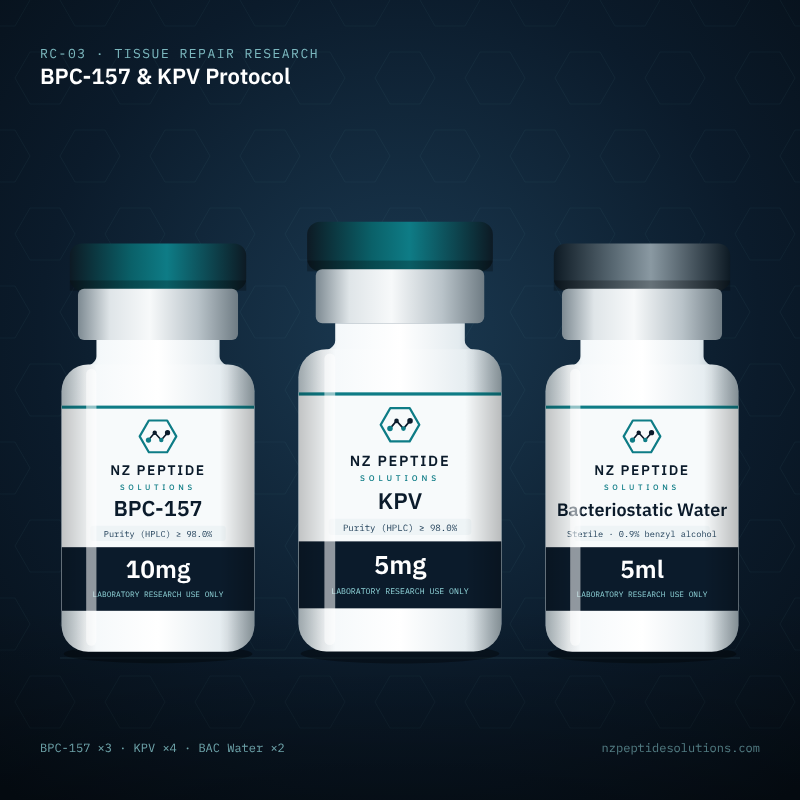
BPC-157 & KPV Protocol
Tissue Repair Research protocol comprising BPC-157 and KPV, with batch Certificates of Analysis.
Research use only. 18+ required. Batch CoA documentation. Secure Stripe checkout. Tracked NZ dispatch.
Specification: Compounds Supplied
Each compound is supplied in matched quantities for the protocol's study design.
| Compound | Vials | Total Quantity Supplied |
|---|---|---|
| BPC-157 10mg | 3 vials | 30mg total |
| KPV 5mg | 4 vials | 20mg total |
| Bacteriostatic Water 5ml | 2 vials | 10ml total |
Research Context
BPC-157 has one of the most robust research profiles for gastrointestinal applications. It is derived from a protective protein found in gastric juice and is studied for gastric ulcer healing, IBD, leaky gut permeability, and gut-brain axis modulation.
KPV (Lys-Pro-Val) is a tripeptide derived from alpha-MSH, researched for anti-inflammatory effects in the intestinal epithelium — suppressing NF-κB signalling and reducing TNF-α and IL-6.
All compounds are sold for research purposes only.
Research context summarises published preclinical literature and makes no claim of effect. All compounds are supplied for laboratory research use only.
Storage & Handling
- - Store lyophilised material at -20°C, protected from light and moisture.
- - Hold reconstituted material at 2-8°C within the validated stability window for the study design.
- - Handle only in an appropriately equipped laboratory using standard PPE.
- - Dispose of material in accordance with local laboratory waste regulations.
Research Use & Handling
Intended Research Use
Supplied for in vitro laboratory research and analytical reference use only. Not for human consumption, animal consumption, diagnostic, therapeutic, cosmetic, or in vivo use of any kind.
Documentation Available
- - Certificate of Analysis (CoA)
- - Batch and lot identification
- - Purity and identity verification by HPLC and mass spectrometry
Handling Notes
Store lyophilised material at -20 degrees C, protected from light and moisture. Once reconstituted, store at 2 to 8 degrees C and use within the validated stability window for your protocol. Handle only in an appropriately equipped laboratory with standard PPE. Dispose of all material in accordance with local laboratory waste regulations.
Full compliance details on our Research Use Only policy page.
Quality & Documentation
Batch Documentation
Certificate of Analysis (COA) available for every batch. Contact us with your batch number for full documentation.
Research literature
12 peer-reviewed references · PubMedPublished studies on the compounds in this research protocol, listed for scientific context. References describe published research only and do not indicate that any product is intended or suitable for human or animal use.
BPC-157
- Emerging Use of BPC-157 in Orthopaedic Sports Medicine: A Systematic Review
Vasireddi N et al. HSS journal : the musculoskeletal journal of Hospital for Special Surgery, 2025Systematic reviewPMID 40756949
- Stable Gastric Pentadecapeptide BPC 157 and Intestinal Anastomoses Therapy in Rats-A Review
Bajramagic S et al. Pharmaceuticals (Basel, Switzerland), 2024ReviewPMID 39204186
- Pentadecapeptide BPC 157 and the central nervous system
Vukojevic J et al. Neural regeneration research, 2022ReviewPMID 34380875
- Stable Gastric Pentadecapeptide BPC 157 and Wound Healing
Seiwerth S et al. Frontiers in pharmacology, 2021ReviewPMID 34267654
- Gastric pentadecapeptide body protection compound BPC 157 and its role in accelerating musculoskeletal soft tissue healing
Gwyer D et al. Cell and tissue research, 2019ReviewPMID 30915550
- Gastric pentadecapeptide BPC 157 accelerates healing of transected rat Achilles tendon and in vitro stimulates tendocytes growth
Staresinic M et al. Journal of orthopaedic research : official publication of the Orthopaedic Research Society, 2003Animal studyPMID 14554208
KPV
- KPV attenuates adipogenesis and lipid metabolism through modulation of ROS-mediated AKT/mTORC1/PPARγ signaling
An SH et al. Tissue & cell, 2026Animal studyPMID 42585803
- Orally Targeted Delivery of Tripeptide KPV via Hyaluronic Acid-Functionalized Nanoparticles Efficiently Alleviates Ulcerative Colitis
Xiao B et al. Molecular therapy : the journal of the American Society of Gene Therapy, 2017Animal studyPMID 28143741
- Drug-loaded nanoparticles targeted to the colon with polysaccharide hydrogel reduce colitis in a mouse model
Laroui H et al. Gastroenterology, 2010Animal studyPMID 19909746
- PepT1-mediated tripeptide KPV uptake reduces intestinal inflammation
Dalmasso G et al. Gastroenterology, 2008Animal studyPMID 18061177
- Melanocortin-derived tripeptide KPV has anti-inflammatory potential in murine models of inflammatory bowel disease
Kannengiesser K et al. Inflammatory bowel diseases, 2008Animal studyPMID 18092346
- Dissection of the anti-inflammatory effect of the core and C-terminal (KPV) alpha-melanocyte-stimulating hormone peptides
Getting SJ et al. The Journal of pharmacology and experimental therapeutics, 2003Animal studyPMID 12750433
Literature compiled from PubMed, 2026-11-24.
Research Use Only: This product is intended for laboratory research purposes only. Not for human or animal consumption. Not intended for medical, diagnostic, or therapeutic use. Read full policy.
From the Research Hub
$349.00
Select format