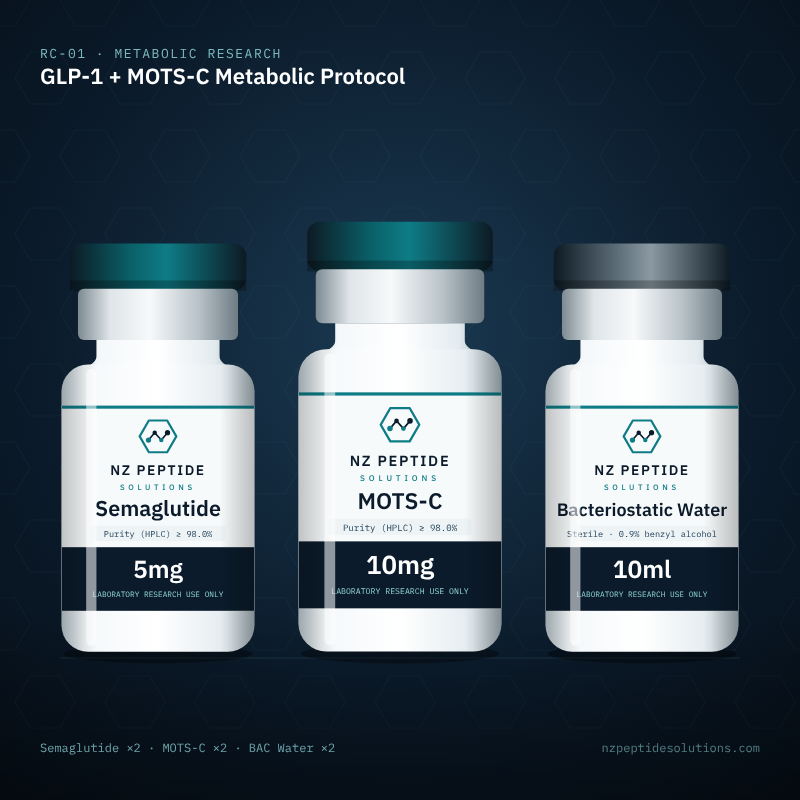
GLP-1 + MOTS-C Metabolic Protocol
Metabolic Research protocol comprising Semaglutide and MOTS-C, with batch Certificates of Analysis.
View protocol reference →Research use only. 18+ required. Batch CoA documentation. Secure Stripe checkout. Tracked NZ dispatch.
Specification: Compounds Supplied
Each compound is supplied in matched quantities for the protocol's study design.
| Compound | Vials | Total Quantity Supplied |
|---|---|---|
| Semaglutide 5mg | 2 vials | 10mg total |
| MOTS-C 10mg | 2 vials | 20mg total |
| Bacteriostatic Water 10ml | 2 vials | 20ml total |
Research Context
Semaglutide is a GLP-1 receptor agonist that reduces appetite, slows gastric emptying, and improves insulin sensitivity. Originally developed for type 2 diabetes management, it has been extensively studied for metabolic and body weight outcomes in non-diabetic populations.
MOTS-C (Mitochondrial Open Reading Frame of the 12S rRNA Type-C) is a 16-amino acid mitochondrial-derived peptide discovered by Dr. Changhan Lee and Dr. Pinchas Cohen at the USC Leonard Davis School of Gerontology. It activates AMPK, the master regulator of cellular energy balance, driving glucose uptake, fatty acid oxidation, and mitochondrial biogenesis.
The combination addresses two limiting factors in GLP-1 adiposity research. Semaglutide creates the caloric deficit. MOTS-C maintains insulin sensitivity and mitochondrial efficiency during that deficit, ensuring liberated fatty acids are oxidised rather than re-accumulated, and that metabolic rate is preserved rather than down-regulated. The same mechanistic rationale underpins the MOTS-C inclusion in the Retatrutide Elite Protocol.
All compounds are sold for research purposes only.
Research context summarises published preclinical literature and makes no claim of effect. All compounds are supplied for laboratory research use only.
Storage & Handling
- - Store lyophilised material at -20°C, protected from light and moisture.
- - Hold reconstituted material at 2-8°C within the validated stability window for the study design.
- - Handle only in an appropriately equipped laboratory using standard PPE.
- - Dispose of material in accordance with local laboratory waste regulations.
Research Use & Handling
Intended Research Use
Supplied for in vitro laboratory research and analytical reference use only. Not for human consumption, animal consumption, diagnostic, therapeutic, cosmetic, or in vivo use of any kind.
Documentation Available
- - Certificate of Analysis (CoA)
- - Batch and lot identification
- - Purity and identity verification by HPLC and mass spectrometry
Handling Notes
Store lyophilised material at -20 degrees C, protected from light and moisture. Once reconstituted, store at 2 to 8 degrees C and use within the validated stability window for your protocol. Handle only in an appropriately equipped laboratory with standard PPE. Dispose of all material in accordance with local laboratory waste regulations.
Full compliance details on our Research Use Only policy page.
Quality & Documentation
Batch Documentation
Certificate of Analysis (COA) available for every batch. Contact us with your batch number for full documentation.
Research literature
12 peer-reviewed references · PubMedPublished studies on the compounds in this research protocol, listed for scientific context. References describe published research only and do not indicate that any product is intended or suitable for human or animal use.
Semaglutide
- Efficacy and Safety of Semaglutide for Weight Loss in Obesity Without Diabetes: A Systematic Review and Meta-Analysis
Tan HC et al. Journal of the ASEAN Federation of Endocrine Societies, 2022Meta-analysisPMID 36578889
- Long-term weight loss effects of semaglutide in obesity without diabetes in the SELECT trial
Ryan DH et al. Nature medicine, 2024Randomised controlled trialPMID 38740993
- Semaglutide 2·4 mg once a week in adults with overweight or obesity, and type 2 diabetes (STEP 2): a randomised, double-blind, double-dummy, placebo-controlled, phase 3 trial
Davies M et al. Lancet (London, England), 2021Randomised controlled trialPMID 33667417
- Dose-response, efficacy, and safety of oral semaglutide monotherapy in Japanese patients with type 2 diabetes (PIONEER 9): a 52-week, phase 2/3a, randomised, controlled trial
Yamada Y et al. The lancet. Diabetes & endocrinology, 2020Randomised controlled trialPMID 32333875
- Effects of once-weekly semaglutide on appetite, energy intake, control of eating, food preference and body weight in subjects with obesity
Blundell J et al. Diabetes, obesity & metabolism, 2017Randomised controlled trialPMID 28266779
- Semaglutide: a key medication for managing cardiovascular-kidney-metabolic syndrome
MacIsaac RJ Future cardiology, 2025ReviewPMID 40458885
MOTS-c
- MOTS-c: A promising mitochondrial-derived peptide for therapeutic exploitation
Zheng Y et al. Frontiers in endocrinology, 2023ReviewPMID 36761202
- MOTS-c: A potential anti-pulmonary fibrosis factor derived by mitochondria
Zhang Z et al. Mitochondrion, 2023ReviewPMID 37307934
- Mitochondrial-derived microprotein MOTS-c attenuates immobilization-induced skeletal muscle atrophy by suppressing lipid infiltration
Kumagai H et al. American journal of physiology. Endocrinology and metabolism, 2024Animal studyPMID 38170165
- The mitochondrial-derived peptide MOTS-c relieves hyperglycemia and insulin resistance in gestational diabetes mellitus
Yin Y et al. Pharmacological research, 2022Animal studyPMID 34798268
- MOTS-c is an exercise-induced mitochondrial-encoded regulator of age-dependent physical decline and muscle homeostasis
Reynolds JC et al. Nature communications, 2021Animal studyPMID 33473109
- The mitochondrial-derived peptide MOTS-c promotes metabolic homeostasis and reduces obesity and insulin resistance
Lee C et al. Cell metabolism, 2015Animal studyPMID 25738459
Literature compiled from PubMed, 2026-11-24.
Research Use Only: This product is intended for laboratory research purposes only. Not for human or animal consumption. Not intended for medical, diagnostic, or therapeutic use. Read full policy.
From the Research Hub
$449.00
Select format